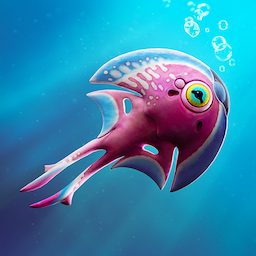
Jetocaris
PDA databank
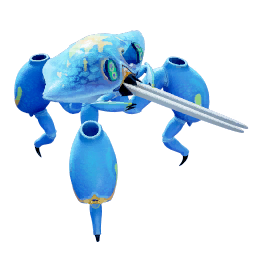
Jetocaris (tentatively *Tripod phrontiscaris*). A three-legged social crustacean that displays parenting behavior.
1. Tripod body plan
Due to early evolution of bilateral symmetry, no three-legged organisms exist on Earth. The jetocaris’ legs may have formed from the fusion of six earlier legs, three on each side. The small forelimbs remained independent.
2. Leg jets
Evolving from leg-mounted gills, a valved thruster on each leg allows the jetocaris to hover and swim. Fusing the legs to double the size of each gill-thruster improves efficiency in simulations.
3. Feeding tongues
The jetocaris deploys two long, flexible radulae (perhaps evolved from food-handling maxillipeds) to search for food. The forelimbs clean and groom the radulae. These appendages are sensitive, but capable of regeneration. This suggests the jetocaris can regrow its nerves—and something in the seabed likes to bite them.
4. Parenting behavior
The jetocaris carries and protects juveniles of the same species, and its expressive body language suggests a dense social life. Spectrogenetic analysis indicates that some juveniles are adopted—they are not genetic offspring of the carer. Adoption has been observed in many species: though it is a mistake from a rational adaptive standpoint. It may be a sign of instinctive behavior. Or perhaps the jetocaris once lived in eusocial groups, with a single reproductive queen producing young that were tended by workers.
Assessment: mostly harmless. May provide emotional benefits.
Behaviour
Profile: Neutral · Large
Targets: Marrowbreach
Stats
Habitat distribution
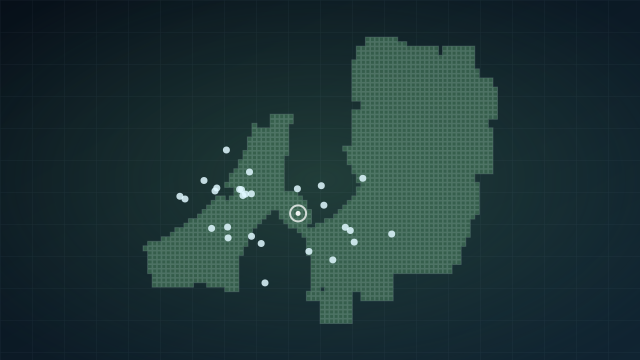
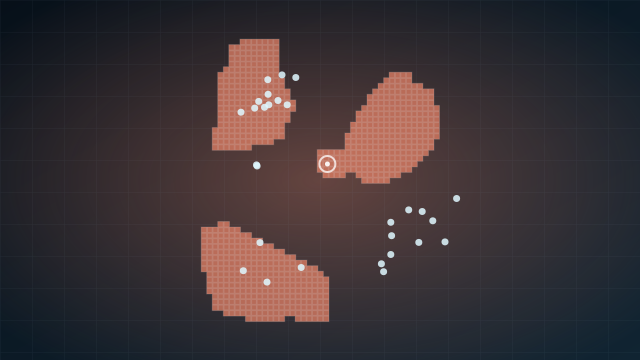
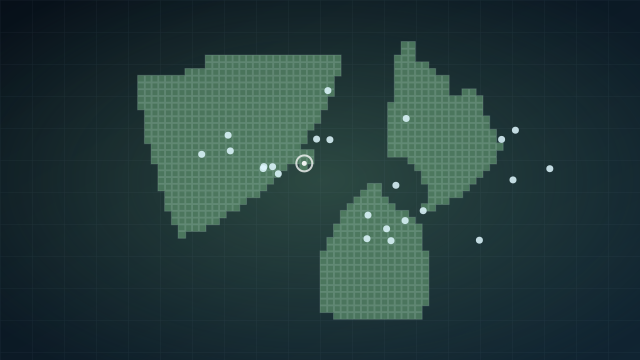
Spawn points · 15
See every spawn on the interactive map, with biome zones and zoom-to-fit.
View spawn points →